
Integrated Protocol for Global Preparedness and Response to Emerging High-Threat Pathogens Identified in 2025–2026: A Multisectoral Framework Aligned with WHO PRET and One Health Principles

Hiba Badr¹, Elkhansaa Mohamed Elsamani²*, Muna Osman³, Manahil Nouri⁴, Dania Attaalla⁵

Authors

  • Hiba Badr Assistant Professor/ Community Medicine Department/National University Author https://orcid.org/0009-0005-1804-4903
  • Elkhansaa Ali Elsheikh Mohamed Elsamani Galway university Hospital, Dermatology Registrar · Galway, IRL Author https://orcid.org/0009-0007-4404-2607
  • Muna Abdelmoniem Mohamed Osman Assistant Professor at Ahfad University for Women/ Faculty of Medicine/ Community Medicine Department. Community Medicine and Public Health Consultant at Non-communicable Disease Directorate/ Primary Health Care Directorate General/ Federal Ministry of Health/ Sudan Sudan Medical Specialization Board (SMSB)/ Primary Health Care (PHC) Committee Rapporteur Author https://orcid.org/0009-0000-5722-6738
  • Manahil Nouri Assistant Professor of Community Medicine, Department of Family and Community Medicine, College of Medicine, Majmaah University, Majmaah 11952, Saudi Arabia. Author https://orcid.org/0000-0003-1199-3346
  • Dania Fateh Elrhman Osman Attaalla Family Medicine specialist/Saudi Arabia Author https://orcid.org/0009-0004-4683-2985

Keywords:

Emerging infectious diseases; high-threat pathogens; One Health surveillance; outbreak preparedness; genomic surveillance; wastewater surveillance; global health security

Abstract

DOI :  https://doi.org/10.5281/zenodo.19313651

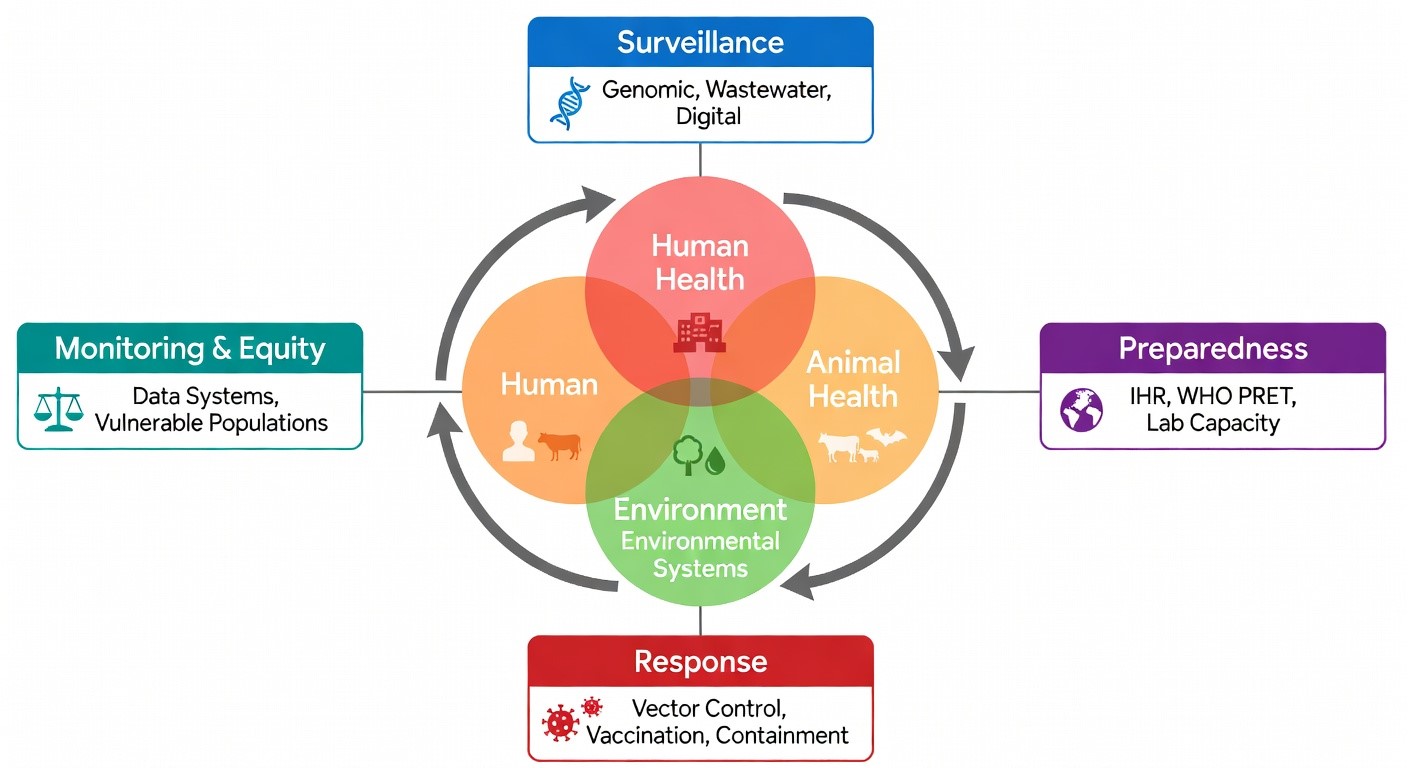
Background: Emerging and re-emerging high-threat pathogens continue to challenge global health security through rapid spread, changing transmission patterns, and uneven preparedness capacity. This review synthesized evidence on surveillance, preparedness, and monitoring systems aligned with One Health principles.

Methods: A systematic review was conducted according to PRISMA 2020. Searches of PubMed, Scopus, Web of Science, Google Scholar, medRxiv, and key institutional sources covered January 2024 to March 2026. English-language records addressing surveillance, outbreak detection, preparedness planning, response implementation, monitoring systems, or multisectoral coordination for emerging or re-emerging high-threat pathogens were eligible. Thirty-six records were included in the qualitative review, and 30 contributed to the final narrative synthesis.

Results: Five domains emerged: genomic and epidemiological surveillance, preparedness gaps, response effectiveness, equity and vulnerability, and environmental surveillance. Included studies showed regional variation in transmission patterns, clustering of mpox cases in high-risk populations and mobility corridors, and reductions in dengue transmission with Wolbachia interventions. The strongest intervention evidence came from Wolbachia studies, while preparedness and policy evidence remained more heterogeneous. Despite increases in outbreak burden, implementation of integrated preparedness strategies remained limited. Wastewater surveillance showed value as a complement to conventional systems.

Conclusion: Evidence suggests that integrated surveillance, response strategies, equity-informed planning, and implementation capacity are central to preparedness for emerging high-threat pathogens. However, conclusions should remain cautious because the evidence base was heterogeneous and narratively synthesized rather than quantitatively pooled.

Downloads

Published

2026-06-26

How to Cite

Integrated Protocol for Global Preparedness and Response to Emerging High-Threat Pathogens Identified in 2025–2026: A Multisectoral Framework Aligned with WHO PRET and One Health Principles: Hiba Badr¹, Elkhansaa Mohamed Elsamani²*, Muna Osman³, Manahil Nouri⁴, Dania Attaalla⁵. (2026). International Journal of Hygiene and Environmental Health , 5(1A), 411-443. https://www.wos-emr.net/index.php/IJHEH/article/view/291

Similar Articles

1-10 of 46

You may also start an advanced similarity search for this article.