Women’s Awareness Regarding Urinary Incontinence in Abbo's Fistula Center in Khartoum Teaching Hospital at Khartoum state, 2021
Yasmeen Omer
Keywords:
Urinary Incontinence, Obstetric Fistula, Awareness, Women’s Health, SudanAbstract
https://doi.org/10.5281/zenodo.20285010
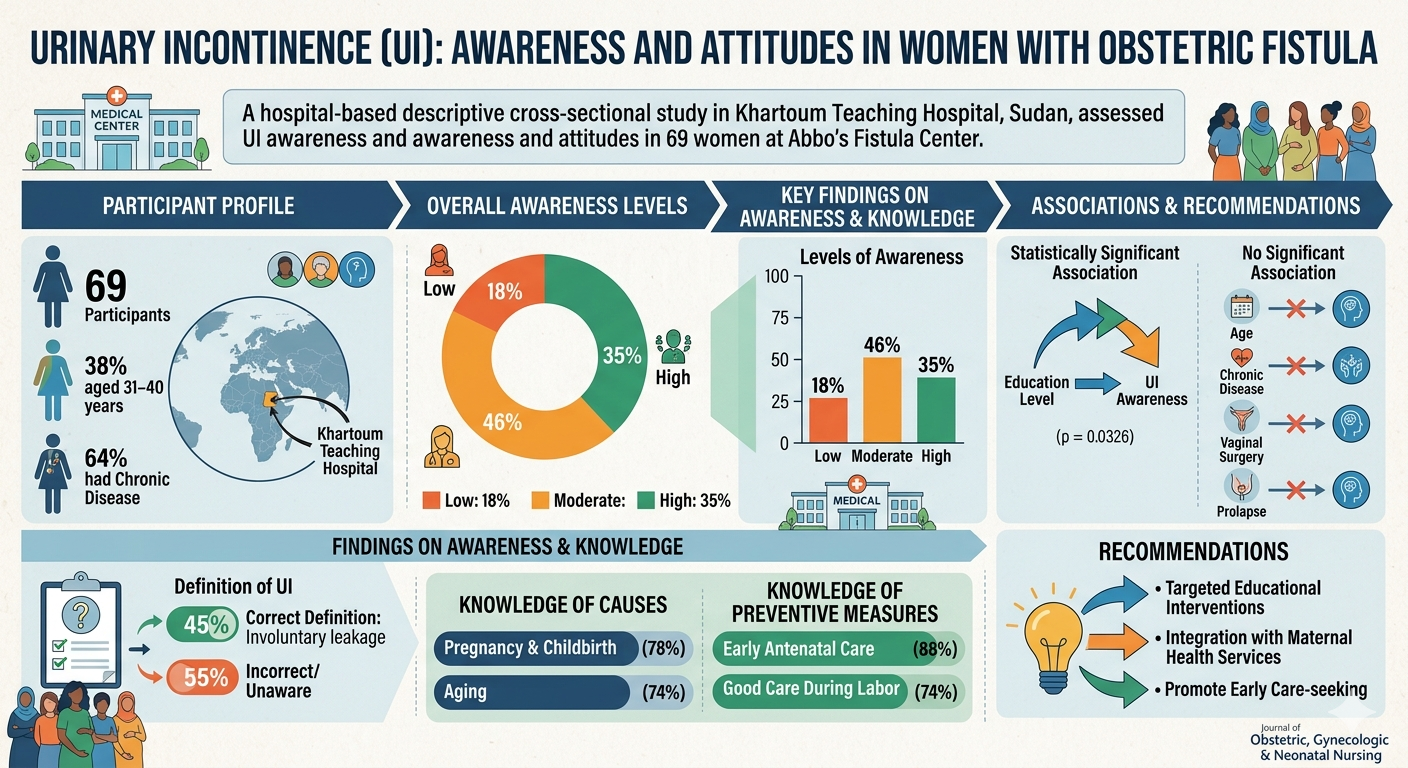
Urinary incontinence is a common and often underrecognized condition that significantly affects women’s physical, psychological, and social well-being, particularly in resource-limited settings where awareness and access to care remain limited. This study aimed to assess the level of awareness and attitudes regarding urinary incontinence among women with obstetric fistula and to examine its association with selected demographic and clinical factors. A descriptive cross-sectional hospital-based study was conducted among 69 women attending Abbo’s Fistula Center at Khartoum Teaching Hospital, Sudan, over a three-month period. Data were collected through face-to-face interviews using a structured questionnaire assessing socio-demographic characteristics and awareness-related domains. Awareness was measured using a 21-point scoring system and categorized into low, moderate, and high levels. The majority of participants were aged 31–40 years (38%), and 64% reported having chronic disease. Overall, 46% of participants demonstrated moderate awareness, 35% had high awareness, and 18% had low awareness. Only 45% correctly identified urinary incontinence as involuntary leakage of urine, while 55% were unaware of its definition. Awareness of causes was highest for pregnancy and childbirth (78%) and aging (74%), whereas awareness of preventive measures was highest for early antenatal care (88%) and good care during labor (74%). A statistically significant association was observed between education level and awareness (p = 0.0326), while no significant associations were found with age, chronic disease, vaginal surgery, or prolapse. The findings indicate that awareness of urinary incontinence among women with obstetric fistula is suboptimal, with significant gaps in fundamental knowledge and preventive practices. Targeted educational interventions, particularly for women with lower educational levels, and integration of urinary incontinence awareness into maternal health services are recommended to improve understanding, reduce stigma, and promote early care-seeking.
Downloads