
Ambient Air Pollution and Dry Eye Disease: A Systematic Review of Epidemiological and Clinical Evidence

Abla Yousif Mohamed Yousif 1, Asim Ahmed 2

Authors

Keywords:

dry eye disease, air pollution, particulate matter, humidity, ocular surface, environmental exposure

Abstract

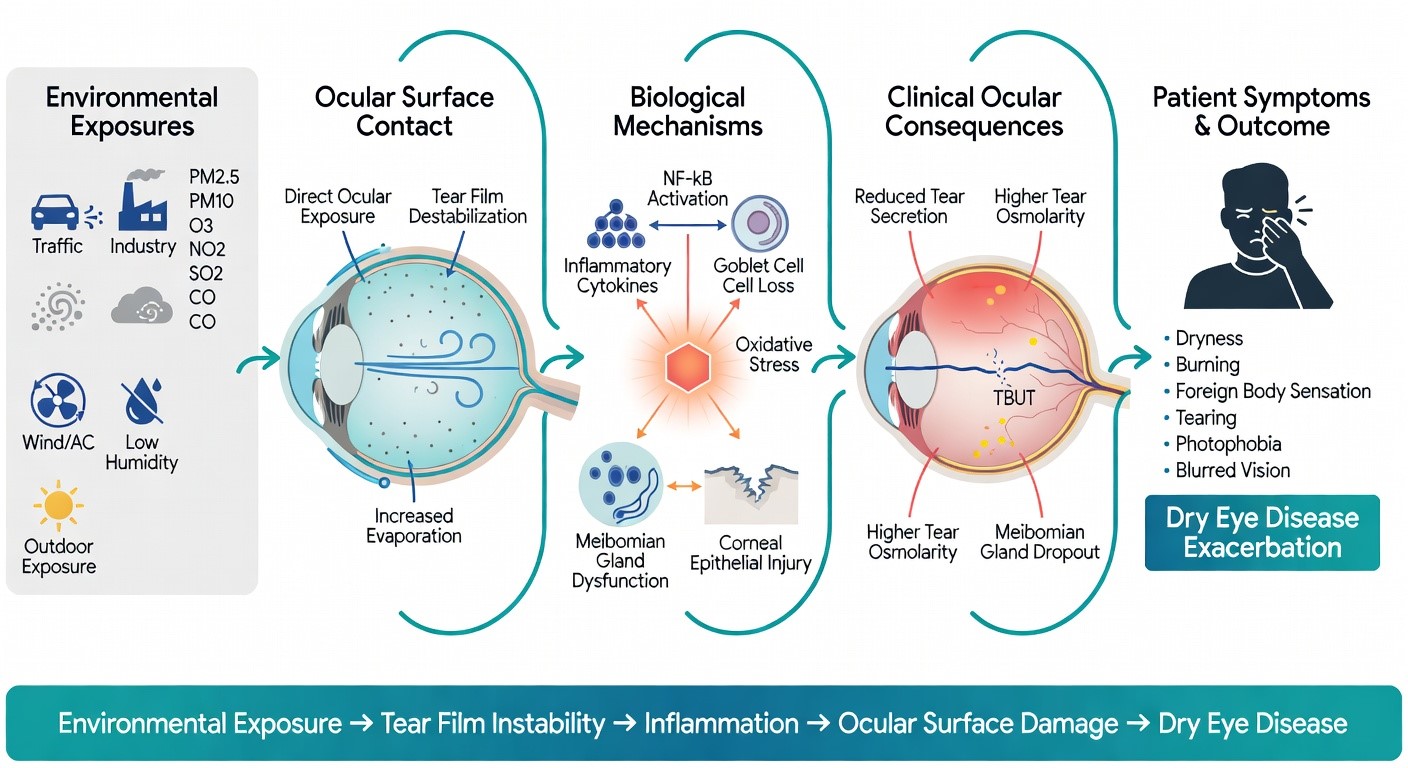
Background: Dry eye disease is a common multifactorial disorder of the ocular surface characterized by tear film instability, hyperosmolarity, inflammation, and visual discomfort. In recent years, growing attention has focused on the role of environmental exposures, particularly ambient air pollution and adverse climatic conditions, in the onset and progression of dry eye disease. This systematic review aimed to synthesize current epidemiological and clinical evidence on the association between ambient air pollution, meteorological factors, and dry eye disease. Methods: A systematic search of PubMed, Web of Science, and Google Scholar was conducted up to 23 March 2026. Eligible studies included original human investigations that assessed ambient air pollutants or environmental stressors such as particulate matter, ozone, nitrogen dioxide, sulfur dioxide, carbon monoxide, humidity, temperature, wind, air conditioning, or greenness in relation to dry eye disease symptoms, diagnosis, or objective ocular surface parameters. Data were extracted on study design, setting, population, exposures, outcomes, and main findings. Due to heterogeneity in methodology and outcome definitions, findings were synthesized narratively. Results: Thirty epidemiological studies and several mechanistic investigations were included. The most consistent associations were observed for particulate matter, ozone, nitrogen dioxide, and low relative humidity. These exposures were linked to increased dry eye symptoms, higher outpatient attendance, reduced tear breakup time, greater tear osmolarity, reduced tear secretion, and increased corneal staining. Sulfur dioxide and carbon monoxide showed less consistent associations across settings. Indoor and occupational exposures, including air conditioning, traffic-related pollution, and dust, also appeared to worsen ocular surface health. Green space exposure showed a potential protective effect in some studies. Conclusion: Ambient air pollution and adverse environmental conditions appear to contribute meaningfully to the development and exacerbation of dry eye disease. The strongest evidence implicates particulate pollutants, ozone, nitrogen dioxide, and low humidity. These findings support the need to integrate environmental exposure history into dry eye assessment and to consider air quality and microclimate improvement as part of broader prevention strategies.

Downloads

Published

2026-03-30

How to Cite

Ambient Air Pollution and Dry Eye Disease: A Systematic Review of Epidemiological and Clinical Evidence: Abla Yousif Mohamed Yousif 1, Asim Ahmed 2. (2026). International Journal of Hygiene and Environmental Health , 5(1), 313-336. https://www.wos-emr.net/index.php/IJHEH/article/view/270

Most read articles by the same author(s)

Similar Articles

1-10 of 31

You may also start an advanced similarity search for this article.