
Water That Carries Disease: Hygiene Failure and the Hidden Drivers of Diarrheal Outbreaks in Urban Settlements

Nikos Papadopoulos¹, Eleni Kosta², Andreas Georgiou³,

Authors

  • Nikos Papadopoulos Department of Epidemiology, National and Kapodistrian University of Athens, Athens, Greece Author https://orcid.org/0009-0005-3861-2816
  • Eleni Kosta Department of Epidemiology, National and Kapodistrian University of Athens, Athens, Greece Author https://orcid.org/0009-0000-6858-3546
  • Andreas Georgiou Environmental Health Unit, Aristotle University of Thessaloniki, Thessaloniki, Greece Author

Keywords:

Diarrheal disease, water hygiene, sanitation, outbreak investigation, environmental health

Abstract

Diarrheal diseases continue to impose a substantial public health burden in densely populated urban settlements, where poor sanitation, unsafe water storage, and inconsistent hygiene practices create ideal conditions for rapid outbreak propagation. This population-based outbreak study assessed the contribution of environmental hygiene failures to diarrheal disease transmission across 18 urban districts between January 2021 and December 2024. A total of 2,860 laboratory-supported or clinically confirmed diarrheal cases were identified, with a cumulative incidence of 17.4 cases per 1,000 population during outbreak periods. Environmental investigation included 612 household water samples, 428 sanitation site assessments, and structured interviews from 1,140 households.

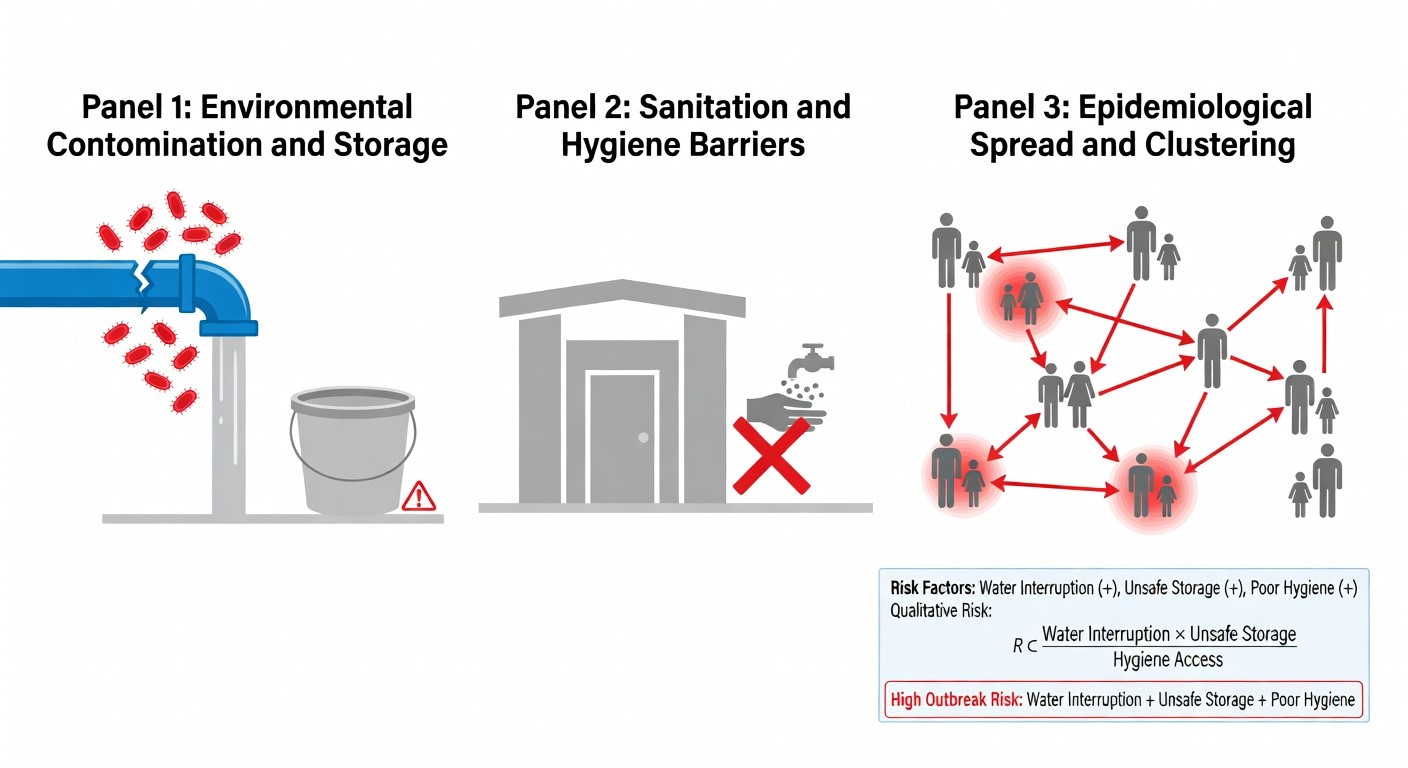
Interrupted piped water supply was documented in 63.8% of affected neighborhoods and was associated with a 2.6-fold higher outbreak risk (RR 2.6, 95% CI 2.1–3.2; p<0.001). Unsafe household water storage practices, including uncovered containers and infrequent disinfection, were observed in 38.4% of affected households, while fecal contamination with E. coli above recommended limits was found in 42.7% of tested water samples. Households lacking functional handwashing stations had 2.1 times higher odds of infection (OR 2.1, p<0.001), and shared sanitation facilities serving more than five households increased transmission risk by 74.0%.

Children under five accounted for 31.6% of total cases, and hospitalization was required in 12.8% of patients. Districts with poor drainage and solid waste accumulation had a 2.9-fold higher likelihood of recurrent outbreak clusters. Following the implementation of water chlorination, hand hygiene education, and household sanitation campaigns, incidence declined by 31.2% within 6 months, while repeat cluster events dropped from 11 to 5 outbreaks.

These findings demonstrate that diarrheal outbreaks in urban settlements are strongly shaped by environmental hygiene breakdowns. Strengthening water quality monitoring, safe storage, and community hygiene interventions may substantially reduce outbreak frequency and disease severity.

Author Biography

Published

2026-03-30

How to Cite

Water That Carries Disease: Hygiene Failure and the Hidden Drivers of Diarrheal Outbreaks in Urban Settlements: Nikos Papadopoulos¹, Eleni Kosta², Andreas Georgiou³,. (2026). International Journal of Hygiene and Environmental Health , 5(1), 337-360. https://www.wos-emr.net/index.php/IJHEH/article/view/269

Similar Articles

1-10 of 39

You may also start an advanced similarity search for this article.