Veiled Signals of the Failing Myocardium: Multimarker Inflammation Trajectories Predicting Silent Heart Failure Progression in High-Risk Adults
Keywords:
Heart failure, inflammation biomarkers, risk prediction, longitudinal cohort, cardiovascular preventionAbstract
Background: Subclinical progression to heart failure often remains undetected until overt decompensation occurs. Inflammatory pathways may provide early signals of myocardial vulnerability, yet their longitudinal predictive value in high-risk adults is insufficiently characterized.
Methods: We conducted a prospective cohort study enrolling 1,042 adults aged 45 to 80 years with hypertension or type 2 diabetes but without clinical heart failure at baseline. High-sensitivity C-reactive protein, interleukin-6, and tumor necrosis factor alpha were measured at baseline and annually for three years. The primary outcome was incident heart failure confirmed by echocardiography and clinical criteria. Multivariable Cox models and time-dependent ROC analyses were applied.
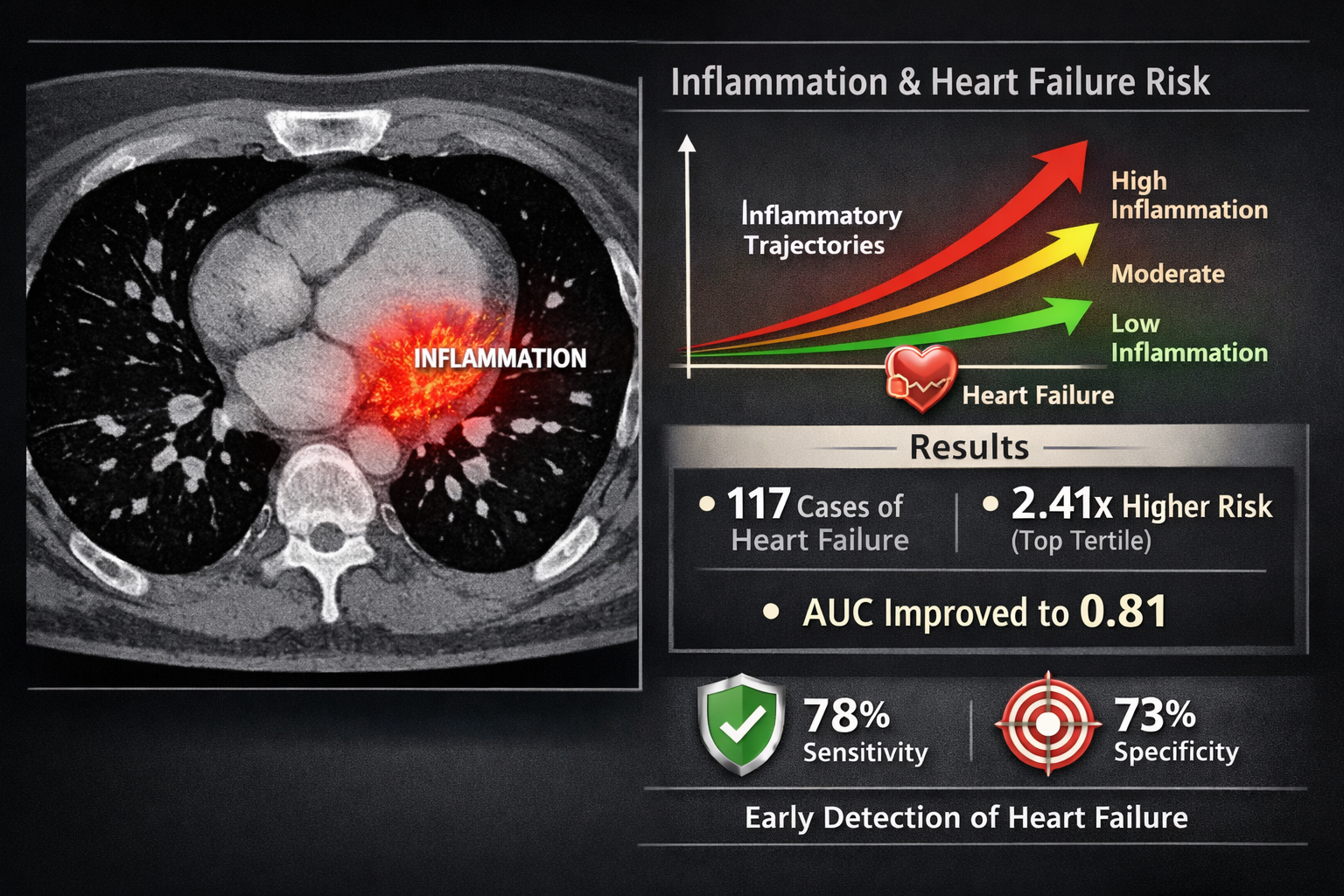
Results: Over a median follow-up of 38 months, 117 participants developed heart failure, corresponding to an incidence of 11.2 percent. Participants in the highest tertile of a composite inflammation trajectory score had a significantly higher risk compared with the lowest tertile with an adjusted hazard ratio of 2.41 and 95 percent confidence interval 1.63 to 3.56, p < 0.001. Each one standard deviation increase in the trajectory score was associated with a 34 percent higher risk of incident heart failure. The model including clinical covariates alone showed an AUC of 0.71, which improved to 0.81 after adding the inflammatory trajectories, p = 0.002. At a predefined risk threshold, sensitivity was 78 percent and specificity was 73 percent. The association remained consistent across subgroups defined by age, sex, and baseline left ventricular ejection fraction.
Conclusion: Longitudinal inflammatory biomarker trajectories provide clinically meaningful early warning signals for silent progression toward heart failure in high-risk adults. Integrating dynamic inflammation profiling into routine risk assessment may enable earlier preventive interventions and more precise cardiovascular risk stratification.
Downloads